There are books that you read. And then there are books that read you.
Never before has writing been as difficult for me as it is now. Perhaps because never before has reading been as difficult as truly understanding this book. The words enter through my eyes, yet not all of them find the same path into my consciousness. Some unfold within me like the gentle ripples of a raindrop touching the surface of still water. Others fall apart before they ever arrive, dissolving into the chaos of not understanding.
Perhaps it is only now that I have realized that the distance between reading and understanding can sometimes span an entire lifetime.
Steiner writes that the human Leib is constituted in such a way that its highest culmination is the organ of the soul—the brain. And yet my own brain now feels as though it is boiling like Mercury in its orbit around the Sun, as if it had ventured too close to the very light it longed to comprehend. Every new thought is born and consumed by that heat at the same moment. Some never even have the chance to be born—they turn to ashes before they can become words. Sometimes I believe that I am thinking. At other times, I feel as though I am merely witnessing a process in which thoughts burn at the cost of their own birth.
The words disappear. The paragraphs disappear. The arguments disappear.
Only three words remain.
Leib. Seele. Geist.
They no longer seem like concepts. They resemble three doors, behind which something is hidden—something I do not yet know, yet that feels strangely familiar. It is as if these words are not merely being read; they are reading the human being from within.
I found myself wondering how this trinity sounds in the language in which it was first written. How Steiner himself names it.
Leib. Seele. Geist.
Not Körper.
But Leib.
How extraordinary that a single word can contain an entire philosophy. Körper—the body as form, as matter, as a visible shell.
Leib, however… already seems to breathe. Here, the body is no longer merely flesh. It is the living body, whose existence is justified not only by its physical reality but also by that invisible dimension Steiner calls Seele and Geist.
Perhaps that is why everything begins with the choice of words.
And perhaps that is why I feel that this book is not trying to teach me something new. Rather, it is trying to remind me of something that has always existed somewhere deep within me.
Perhaps that is why understanding is so painful. Every genuine thought first destroys the world in which you had lived so peacefully—and only then does it begin to build a new one.
Perhaps that is why only the living can give birth to the living.
Blog
-
The Living Gives Birth to the Living
-
Nobody has Opinions anymore
It is harder than ever to find truly interesting people nowadays. Everyone is average. Everyone is afraid. Nobody dares to say anything controversial anymore. Women are affected by this more than men. Dating apps are a prime example of this. Ten minutes on Hinge will fry your last brain receptors:
“I want to travel.”
“I like good food.”
“I go crazy for coffee in bed.”
“Make me laugh.”
“ChatGPT is my therapist.”No, Lisa, even if you look decent, I am certainly not interested in a woman who is just another product of social media and TikTok culture. Nothing you say or think is unique. You spend hours a day consuming the outputs of Instagram, TikTok, and ChatGPT. I don’t want to spend time with someone whose brain has been molded by big-tech overlords to be as average as possible. I could replace you and your entire existence with just another Lisa.
Have fun finding an Otto who will go on all those trips, eat at fancy Instagram restaurants with you, while you consult ChatGPT for “Why is our relationship boring?”.
Have fun dying without being remembered. I hope you enjoyed the Instagram likes and the Reddit upvotes.
-
Für niemanden. Von niemandem.
In einer Novelle heißt es, dass alles mit einer Einleitung beginnen sollte. Das stimmt – also beginne auch ich mit einer Einleitung.
Es ist schwer, für jemanden zu schreiben, der vielleicht gar nicht existiert. Deshalb ist diese Seite und alles, was hier geschrieben steht, für niemanden – von niemandem.
Als ich mein Studium beendet hatte – was noch gar nicht so lange her ist –, beschloss ich, eine Vorlesung meines Lieblingsdozenten zu besuchen. Nach der Vorlesung unterhielten wir uns lange. Ich erzählte ihm, wie verzweifelt ich war, weil ich den Sinn des Lebens nicht mehr sehen konnte; dass mir, anders als Newton, kein Apfel auf den Kopf gefallen war und ich nichts Außergewöhnliches entdeckt hatte.
Er lächelte und sagte mir, dass Menschen aus den Sozialwissenschaften Zeit und Lebenserfahrung bräuchten, um etwas wirklich Neues zu erkennen – anders als Physiker oder Mathematiker. Um meine Seele ein wenig zu beruhigen, fügte er hinzu, dass er mir ein Buch mitbringen könne, das mir helfen würde, mich selbst besser zu verstehen. Gleichzeitig murmelte er jedoch, wie schwer dieses Buch eigentlich zu begreifen sei.
Voller Ungeduld wartete ich auf die nächste Woche, um wieder zur Universität zu gehen und das versprochene Buch entgegenzunehmen. Ich zählte die Sekunden, bis ich endlich mit dem Lesen beginnen konnte. Und dann hielt ich es in den Händen: Rudolf Steiners Theosophie, eingehüllt in einen leuchtend roten Einband. Kaum hatte ich die Universität verlassen, schlug ich das Buch auf. Die georgische Übersetzung stammte von Swiad Gamsachurdia und Merab Kostawa – dem ersten Präsidenten Georgiens beziehungsweise einem Nationalhelden des Landes. In genau diesem Moment wurde mir klar, wie schwierig die Lektüre werden würde. Doch das war erst der Anfang.
Schon im ersten Kapitel, das eigentlich nur eine Einleitung ist, wurde ein Auszug aus einer Lehre Johann Gottlieb Fichtes zitiert, die im Herbst 1813 veröffentlicht wurde:
„Zum Verständnis dieser Lehre bedarf es eines völlig neuen inneren Sinnesorgans, das eine neue Welt wahrnimmt, die dem gewöhnlichen Menschen verborgen bleibt.“
Als ich diese Worte las, erfüllte mich eine tiefe Angst vor der Gewöhnlichkeit. Denn wie Shakespeare einst schrieb: Nichts ist so weit verbreitet wie der Wunsch, anders zu sein.
Ich begann mich von einer einzigen Formulierung verfolgen zu lassen: „dem gewöhnlichen Menschen verborgen.“ Was bedeutet überhaupt ein gewöhnlicher Mensch? Kann ein Mensch gewöhnlich sein, wenn doch allein seine Existenz bereits etwas Außergewöhnliches ist? Und selbst wenn wir den größten Teil der Menschheit als „gewöhnlich“ bezeichnen – so wie es uns die Normalverteilung in der Psychologie der menschlichen Entwicklung nahelegt, nach der die meisten Menschen einander ähneln und nur wenige Ausnahmen darstellen –, ist dieses Buch dann nur für eine kleine Minderheit bestimmt?
In diesem Moment spürte jede einzelne Zelle meines Körpers eine überwältigende Angst. Was, wenn ich ein gewöhnlicher Mensch bin? Was, wenn mir genau jenes „völlig neue innere Sinnesorgan“ fehlt, von dem Fichte spricht?
Es war nicht die Angst davor, gewöhnlich zu sein. Es war die Angst, den Menschen zu enttäuschen, der mir dieses Buch geschenkt hatte – einen Menschen, der für mich zu den außergewöhnlichsten Persönlichkeiten meines Lebens gehört. Deshalb schaffte ich es, nur siebzehn Seiten zu lesen. Denn jedes Mal, wenn ich eine Seite berührte, empfand ich nicht die Freude des Lesens, sondern die lähmende Furcht, einer Erwartung nicht gerecht zu werden.
Seitdem sind nun sieben Monate vergangen, lieber Leser.
Und genau darum geht es in diesem Blog: um Rudolf Steiners Theosophie und um all die Gedanken, die während der Lektüre dieses Buches in mir entstehen werden. Denn ich war nie gewöhnlich. Und vielleicht ist jetzt der richtige Zeitpunkt gekommen, eine weitere neue Seite aufzuschlagen.
-
Not having an AC because of CO2 Emissions is a Scam
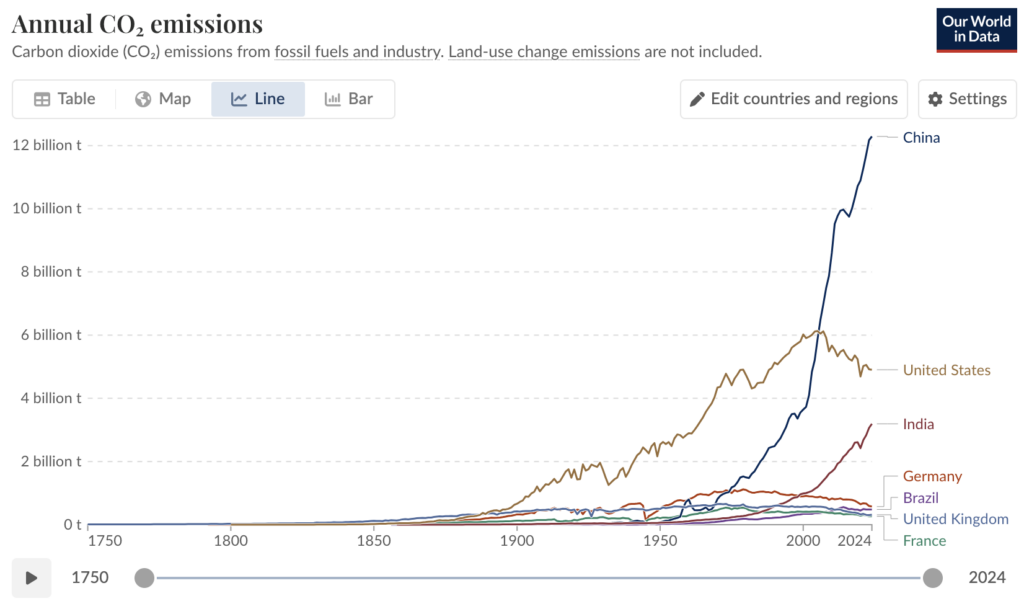
Yes. As an European not having an AC because of “muh CO2” emissions is a scam. Look at the chart below:

China currently dominates global CO2 emissions, producing nearly 24 times the amount generated by Germany. While Europe undergoes a period of de-industrialization, China continues to expand its industrial footprint. It is clear that China will prioritize its economic lead over environmental concerns. Consequently, Europeans must find a balanced approach. Ensuring proper climate control in schools, offices, and clinics is not merely a matter of comfort, but a fundamental requirement for a nation’s well-being. It dictates a country’s ability to provide students with optimal learning environments, workers with productive conditions, and patients with the necessary surroundings for a speedy recovery.
-
Hallo Welt!
Willkommen bei WordPress. Dies ist Ihr erster Beitrag. Bearbeiten oder löschen Sie ihn und beginnen Sie mit dem Schreiben!